April 19, 2026
History of Voluntary Euthanasia in Australia
Voluntary Euthanasia in Australia by Philip Nitschke
An earlier edit of the below is published in Killing Me Softly: Voluntary Euthanasia and the Road to the Peaceful Pill (Penguin 2005).
On 1 July 1996 the Rights of the Terminally Ill Act (ROTI) became law in Australia and made history around the world.
Yet the ink on the Act was never allowed to dry because even before the Bill was even enacted, conservative backbencher Kevin Andrews was consulting then Prime Minister, John Howard, about the possibility of introducing a private member’s bill in Federal Parliament to overturn the ROTI Act.
In the months after 1 July 1996, opposition to the Act began emerging from far and wide, but especially from the Catholic Church.
In Darwin in the Northern Territory, opposition came primarily from within the government’s own Country Liberal Party ranks.
Chief Minister, Marshall Perron, retired from office on the eve of the passing of the ROTI Act.
His retirement handed power to his deputy, Shane Stone. It was obvious the road was going to be rough.
A practicing catholic, Shane Stone was openly hostile to voluntary euthanasia. However, it was Stone who was now in charge with the ROTI Act’s full implementation.
A close confidant of John Howard, Stone was canny enough to realise that he needed to be seen to support the bill’s implementation.
He was also clever enough to know that he had a range of options by which he could help bring the Act down.
One of the first scare tactics used was to allow the Territory’s Department of Health to join forces with Australian Medical Association (AMA). AMA President, Chris Wake was another who was also hostile to the issue.
In turn, Chris Wake was supported by such local power brokers as the then Catholic Bishop of Darwin, Ted Collins.
To this end, a letter detailing an obscure legal risk was mailed to all doctors in the Northern Territory.
In the letter it was suggested that doctors could face retrospective prosecution if the bill was ever deemed unconstitutional.
Even though the ROTI law was never found to be unconstitutional, the damage was done.
It would take another three months before I could find enough doctors to be bold and brave and break ranks with the AMA to help the law to be used as intended.
Another strategy to bring down the law was the ‘Kevin Andrews Bill’, which became formally known as the Euthanasia Laws Act.
The Kevin Andrews Bill
On 25 March 1997 the ‘Kevin Andrews Bill’, formally known as the ‘Euthanasia Laws Bill’, passed via a conscience vote in Australia’s Federal Parliament in Canberra.
A letter appearing in the Sydney Morning Herald the following day summed things up from a democracy perspective.
I have heard that early this morning, in the Senate, the lights went out.[1]
Two days later, then Governor-General, Sir William Dean, ratified the bill and the Northern Territory ROTI Act ceased to exist. I was simply devastated.
The way I felt is perhaps best encapsulated in a photo taken by a Fairfax press photographer that shows me standing on the steps of Parliament House, surrounded by the journalists of the press gallery, with burning copies of the ROTI Act and the Northern Territory’s Constitution at my feet.
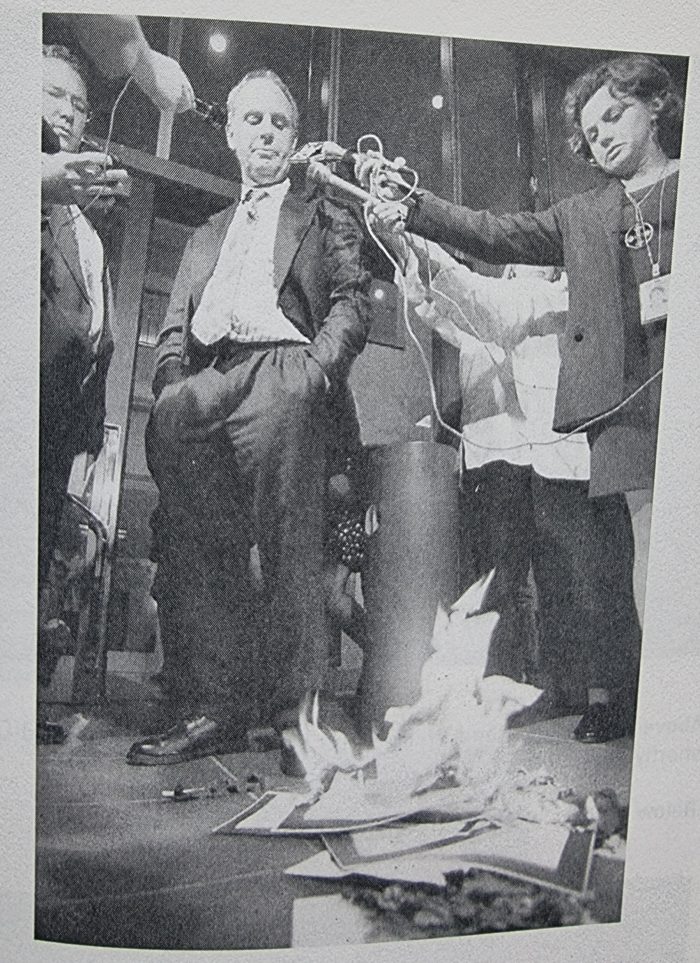
The burning of the NT Constitution & Rights of the Terminally Ill Act
in the early hours of 24 March 1997
The burning was a symbolic act. I felt the wishes of most Northern Territorians lay in ashes at the feet of our federal politicians.
How could this Destruction of Democracy happen?
The fact that the Federal Parliament was able to override the legislation of the Northern Territory through use of Section 122 of the Australian Constitution is only half the story.
The other half concerns a wide-reaching network of people, many from within the Lyons Forum and catholic Church-based propagandists.
This network included the former Young Labor president Tony Burke – and now Minister for Home Affairs, Immigration and Citizenship –and Sydney businessman Jim Dominguez, the ‘Euthanasia No’ campaign was well-funded and effective.[2]
In the words of the late journalist Michael Gordon, the No campaign was a ‘story of a network [where] all the principals are Catholics – its influential connections, its single-mindedness and the tactics it employed’.[3]
The Role of the Media
A second group that ensured the success of the Kevin Andrews’ Euthanasia Laws Act was the media, most particularly the Murdoch-owned, Australian newspaper.
As a prominent member of the ‘Euthanasia No’ campaign, then editor-in-chief, Paul Kelly, used his position at the paper to promote ‘Euthanasia No’. He was, and is, personally opposed to any kind of voluntary euthanasia legislation.
Kelly’s complicity in the No campaign was revealed to me by The Australian’s then Darwin correspondent, Maria Ceresa.
While her Fairfax counterpart, journalist Gay Alcorn, filed stories without editorial interference, Ceresa said she was routinely thwarted by the paper’s hierarchy in her coverage of the issues surrounding the ROTI law.
Ceresa would later tell me that unless the story was highly critical of the legislation, the paper would not run it. She felt herself professionally compromised as a result.
The Australian Right-to-die Movement
The right-to-die movement, too, found itself unwittingly helping to undermine the legislation.
I knew something was not right as I travelled from state to state during 1996, trying to involve the state Voluntary Euthanasia Societies. I tried to get them to mount a coordinated campaign to save the ROTI Act.
Their response was patchy.
Although representatives from Queensland, South Australia and the ACT did gather for a strategy meeting in Canberra, there was little willingness to pool resources and mount a national campaign.
The Victorian society, who did not even attend the meeting. They said they were unwilling to put money into a project that would not directly benefit Victoria.
Later I met with the president, Dr Rodney Syme, and the then executive officer, Kay Koetsier, whereupon they expanded on this view.
Syme explained that while the society was prepared to pay for survey work that could benefit Victoria, there would be no involvement in a national campaign to lobby federal politicians.
Koetsier went so far as to claim that the passage of the Andrews Bill could even bode well for Victoria.
When I asked Koetsier to elaborate on this point of view, she said that if the Senate voted in favour of the Andrews Bill, there would be a national outcry.
She said that the then Premier of Victoria, Jeff Kennett, would take it upon himself to ‘do the right thing’ for the people of that State, and pass right-to-die legislation. Wishful thinking at best, naive stupidity otherwise.
History now tells us that it took another 20 years for the Victoria Parliament to ‘do the right thing’.
In retrospect, it was little wonder the ‘Euthanasia Yes’ campaign was defeated.
The Vote – who said what & why?
When the Euthanasia Laws Bill was debated in the Senate, the debate lasted the best part of four days. The speeches heard in both houses of parliament were some of the most emotional ever made.
While some MPs spoke about the rights of the individual, others echoed the Catholic Church. A few talked critically of State/Territory versus Commonwealth powers.
The speech of Labor frontbencher Anthony Albanese (now Australian Prime Minister) is of note for its eloquence and passion:
‘This debate is hard – real hard,’ Albanese said. ‘It is hard because it is about death.’
He went on:
Most people are uncomfortable talking about dying … [Yet] this debate, as hard as it may be, is important. The outcome of this debate will reflect on our maturity both as a parliament and as a nation for it will determine the manner in which we seek to control each other’s lives.
I oppose this [Andrews] bill because I support human dignity. I oppose this bill because I support freedom of choice. I oppose this bill because I support civil liberties. I oppose this bill because my Christian upbringing taught me that compassion is important. I oppose this bill because modern medical practice should be open and accountable, not covert and dishonest…
I oppose this bill because I oppose the moral posturing of the Lyons Forum. I oppose the hypocrisy of those who say, ‘This debate is so important’ and then vote to debate it upstairs in sideshow alley.
Most importantly, I oppose this bill for one critical reason, and that is this. We have all accepted that this parliamentary debate should be a matter for our conscience.
How arrogant to then suggest that the ability to exercise conscience should be taken from a seriously ill patient who wants to die. There is nothing moral about our exercising a free conscience vote as members of parliament and then voting to deny to others the right to exercise their conscience.
What possible right do Kevin Andrews, Leo McLeay, Lindsay Tanner or Anthony Albanese have to have exercised Bob Dent’s conscience for him? It was his decision and he had a right to do that.[4]
The Territory Rights Argument
Of those who focused on territory rights, it was the Northern Territory’s own Senator Bob Collins who led the way.
Although a hostile opponent of the ROTI law, Collins was angry at the vilification of both the Territory and its politicians by Federal Parliamentarians. He was especially critical of Kevin Andrews and then Senator Eric Abetz from Tasmania.
He was angry at Andrews for his audacity to think that ‘Territorians have no rights, only obligations’.
Collins was also scathing of Abetz when the latter had tried to argue that ‘the Northern Territory parliament exists only by the grace and favour of the Commonwealth parliament. What the Commonwealth parliament gives, it can also take away’.
‘This’, said Collins, ‘from a senator from a state with about twice the population of the Northern Territory’s, and five times its representation in the House of Representatives and six times its representation here in the Senate’.
Other politicians focused more on their own moment in history.
Citing Edmund Burke, Barry Jones stated that he as ‘your representative’, ‘owes you, not his industry only, but his judgment; and he betrays instead of serving you if he sacrifices it to your opinion’.[5]
Barry Jones’s mistake was to believe that it was appropriate for politicians to dismiss the ‘opinion’ of their electorates in favour of their own prejudices. Politicians like Barry Jones thought they could do our thinking for us.
Letters to the Editor
The irony of these political machinations is that then, as now, the majority of the Australian population supported a terminally ill person’s right to seek medical help to have a peaceful death. The overturning of the Rights of the Terminally Ill Act was a deeply unpopular act of democratic bastardry.
Letters to the editor of the Sydney Morning Herald reflected the popular sentiment.
It was Greens leader, Bob Brown, who had the foresight to incorporate the many letters into Hansard.
But he had opposition even in this small but significant step.
Senate Hansard, Parliament House Australia – 26 March 1997
Senator BROWN (Tasmania) (Midnight) – The letters columns in today’s newspaper started to reflect the feeling of the Australian people about the failure of this parliament to uphold the voluntary euthanasia laws. I do not wish to hold the chamber for long at this point but I have circulated –
Senator Chris Ellison – Why not; you’ve done it all week. You’re a disgrace.
Senator BROWN – The honourable senator … I want to incorporate into Hansard the page of letters in today’s Sydney Morning Herald published under the heading ‘Senate’s night of shame’. I seek leave, having circulated this page, to have it so incorporated.
Leave granted …
Senator Bob BROWN – The letters speak for themselves. They are a consistent barrage of vitriol, disappointment and disgust with the fact that the rights of individuals in this country have been overridden by a majority of people in this parliament not reflecting what the people themselves think…
Senator Kay Patterson – I find that offensive; you are appalling.
Senator Bob BROWN – You may find that offensive, but I find what you did offensive in the extreme. The difference between you, Senator Patterson, and me – through you, Madam President – is that I have not voted to override the right of individuals. If you want to get up to defend your position, you do so, but I stand here on the point I take and I stand defiant of your point of view.
A Sample of Sydney Morning Herald Letters to the Editor
I don’t understand why these evangelists of their own belief systems have the right to take away another individual’s right to end his or her own suffering.
This is the worst kind of politicking, far worse than acting out at Question Time, making errors with expenses or jetting around on fact-finding missions. I don’t care what ‘God’ a politician chooses to follow, but when his belief affects others I consider he has overstepped his already poor standing in the community.
My heart goes out to those who are suffering and those wanting to help them within the law – Letter to the Editor, Sydney Morning Herald, 25 March 1997.[6]
~~
Makes me feel all warm and fuzzy. I don’t have to worry about what’s best for me. A very few altruistic-minded wise persons in Canberra tell me what’s best. I feel good. I don’t need God. I have them – Letter to the Editor, Sydney Morning Herald, 25 March 1997.[7]
~~
To all the senators who voted in favour of the Andrews euthanasia bill: you disgust me. You have shown that in Australia, as in the United States, the ‘moral majority’ is on the rise.
You seek to impose your religious and moral beliefs upon the wider community. You missed the point. You can’t stop me gassing myself, or driving my car off a cliff. It’s my life and I will control it, thanks very much.
All you have done is to remove a humane and merciful option. In doing so, you have run rough-shod over public opinion and the rights of the individual. Thanks to your vote, euthanasia will continue to be practised in secrecy every day in every major hospital in Australia.
~~
When society matures further, a euthanasia law will be passed. As with most issues, I doubt that Australia will be in the vanguard of change – Letter to the Editor, Sydney Morning Herald, 25 March 1997.[8]
~~
May I wish Mr Kevin Andrews a long and excruciatingly painful life – Letter to the Editor, Sydney Morning Herald, 25 March 1997.[9]
~~
Australia has just thrown away an opportunity to show the world that we have a compassionate and caring society which allows our terminally ill people the right to choose how and when they will die. To deny this right to anyone in pain and without hope is the ultimate act of obscenity.
The point that these meddling minders have apparently missed is that palliative care does not work for many patients and even when pain can be alleviated there is another equally important aspect to their suffering to consider – dignity.
I ask this: have any of you who so vehemently oppose voluntary euthanasia ever watched someone you love die in mental and physical agony, inch by inch? Well, I have, and it is a predicament that even the most blasé of us never forget. Certainly, if it happened to the family dog, it would not be tolerated. – Letter to the Editor, Sydney Morning Herald, 25 March 1997[10]
Conclusion
The Euthanasia Laws Act and the overturning of Australia’s Rights of the Terminally Ill Act came about as a result of a complex, underhand and underground network of anti-choice activists and politicians who succeeded in ramming through one of the most undemocratic and unfair legislative amendments in Australian political history.
The one common thread binding most, but not all of the political players, was their Christian faith. Ironically, the Northern Territory of Australia was and remains the least religious jurisdiction in Australia.
This betrayal of democracy is a stain on our country. It should never have happened. This is not how the rule of law looks, not even in Australia.
Footnotes
[1] Sydney Morning Herald, 25 March 1997 (Senate Hansard, March 26 1997).
[2] As early as May 1995 at the invitation of The Australian’s national affairs editor, Mike Steketee, Jim Dominguez would appear in the paper under the guise of opinion writer and in the letters to the editor. All the while his biography would fail to acknowledge his early commitment to the Euthanasia No campaign. Instead, he appeared variously as ‘Jim the Banker’, and ‘Jim from Hunters Hill’.
[3] Michael Gordon, 1997. A full analysis of the Euthanasia No campaign can be found in Gordon’s 1997 article in the Weekend Australian entitled ‘Holy Alliance: The Inside Story of Euthanasia’s Demise’, 29 March 1997.
[4] Australia, House of Representatives, 1996, Speech, Second Reading Euthanasia Laws Bill 1996, p. 5920.
[5] Australia, House of Representatives, 1996, Speech, Second Reading Euthanasia Laws Bill 1996, p. 7325.
[6] Sydney Morning Herald 25 March 1997, (Senate Hansard, 26 March 1997).
[7] Senate Hansard, 26 March 1997.
[8] Senate Hansard, 26 March 1997.
[9] Sydney Morning Herald, 25 March 25 1997, (Senate Hansard, 26 March 1997).
[10] Senate Hansard, 26 March 1997.
Exit