March 23, 2026
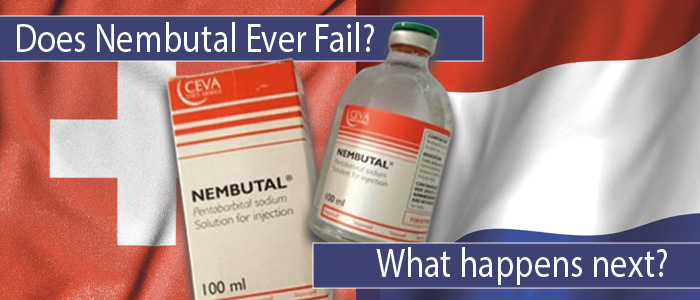
When Nembutal Fails: Legal Road Blocks & Politics
In many ways, last Tuesday was just another day in my life as an end of life rights activist – until it wasn’t.
What made it a bit different was an email I received from a journalist I thought I knew well in Switzerland.
She had always seemed to have a genuine interest in understanding the intellectual nuances of the right to die debate – until she didn’t?
Her email to me last Tuesday read:
While doing my research, I came across a March 2025 newsletter from Exit International titled “Does Nembutal Cause Subjective Drowning?” In it, you raise questions that I’m hearing for the first time and that don’t seem scientifically sound to me, especially since Nembutal has been used in Swiss assisted suicide for decades. Can you tell me the source for these concerns you’ve raised? I have been told that your main aim in doing this was to sow doubt about the activities of Swiss organizations. How do you respond to that?
I thought to myself, what an extraordinary statement to make.
Then I thought, who would try and spin a global public discussion of ‘does Nembutal cause subjective drowning’ as a personal attack on the ‘activities of Swiss organisations’.
Of course, the debate about the type of death that Nembutal brings about is long-standing, and has precious little to do with Switzerland.
Rather, this has everything to do with the politics that surround capital punishment in the US.
Around the world, capital punishment rightly remains a hugely controversial topic and practice.
For decades I have been one of hundreds (maybe thousands) of scientists/ human rights activists who have been trying to use my scientific knowledge and experience to stop this state-sanctioned killing.
My history in advising on capital punishment
My involvement in advising on ways to stop capital punishment dates back a long way. In 2009, for example, I collaborated with Allen Bohnert of the Public Defenders Office in Columbus Ohio in their attempt to argue that the single-drug protocol that was proposed by the State for the execution of Ken Biros was ‘cruel and unusual punishment’.
A prohibition on cruel and unusual punishment is the 8th Amendment to the US Constitution.
What counts as ‘cruel and unusual’ matters as it can save lives: the lives of the men and women on death row.
However try as one might, it remains an almost impossible task to argue that death by Nembutal is cruel and unusual.
One person who has had more success in terms of arguing against the use of Nembutal in capital punishment has been Dr Joel B. Zivot of Emory University Medical School.
I won’t go into Zivot’s argument here other than to say that in my opinion he has wilfully and deliberately twisted the science to support his anti-death penalty politics.
I agree with his politics. I do not agree with his misuse of science to support his political ends in what has been suggested to be an orchestrated second career in the media.
Note – I explore in-depth the whole ‘does Nembutal cause subjective drowning’ issue in my March 2025 online Snippet (now published in the online Peaceful Pill eHandbook).
The Peace of a Nembutal death
For the most part, Nembutal deaths are peaceful and reliable, regardless of whether the drug is administered orally or intravenously.
Back in Darwin in 1996-97 under Australia’s Rights of the Terminally Ill Act, I used Nembutal to help my four, terminally ill patients get the death they so desired.
The deaths of these people were nothing but peaceful. Their duration varied to some extent.
In the Netherlands, where I have lived for over a decade now, Nembutal is also used.
Throughout Holland the drug tends to be administered intravenously – an increasing choice of the part of patients.
It is also the drug used in most other jurisdictions where some form of assisted dying is legal.
Nembutal is not used in the US because it has been ‘politically-priced’ out of reach of most people.
Such is the controversy of the intersection of capital punishment and Medical Aid in Dying (MAiD) in that country.
Two forms of killing, one compassionate and the other anything but.
Instead in the US, a 5-drug mixture has been introduced which, according to its creators, Lonny Shavelson and his colleagues, is more reliable and often faster than Nembutal. It is also vastly cheaper.
When Things go Wrong
However, not every death from Nembutal is straight forward, things can and do go wrong.
In an article published this month on the Medscape website by a preeminent science writer (Manuela Callari) this point is explored in some detail.
Callari examines the differences in disclosure between various countries where assisted dying/ voluntary euthanasia/ assisted suicide are legal.
She makes several important points in her article:
- In countries where assisted suicide/ dying and euthanasia are legal, when something goes wrong with Nembutal, it is not that serious as the doctor can step in to repeat the procedure or take other steps
- In Switzerland where assisted suicide ONLY is allowed, a failure with Nembutal is serious. As the person assisting cannot take further action: at least not without breaking Switzerland’s Criminal Code
- So what happens where the death goes wrong in Switzerland? No one is saying
- The lack of data on the off-script use of sodium pentobarbital in assisted dying leaves a gaping hole in the scientific literature. This surely demands greater attention and examination
Titled ‘The final journey is not always peaceful: Why euthanasia is less well researched medically than life-saving treatments’ Callari’s article constitutes a much-needed critical look at the use of Nembutal as an end of life agent.
The article also raises important questions.
These questions are not a personal attack on assisted suicide practice in Switzerland or elsewhere.
They are questions which rigorous science demands to be asked and which the recipients of assisted suicide (in Switzerland) deserve to have answered.
Addendum
In closing, I would add that the same arguments for/ against the use of Nembutal in capital punishment are now being rehashed in the context of the use of nitrogen hypoxia.
The same intersections are being encountered between capital punishment and elective peaceful assisted dying.
On the one hand, are reports of gasping, suffocation and lashing around by those dying on death row.
On the other, is the long history of eye-witness accounts of peaceful dying from the use of inert gas and plastic exit bags and, more recently, from the Sarco in Switzerland back in September 2024.
The Exit June 2025 Snippet on ‘does Nitrogen hypoxia cause convulsions’ examines the politics and the science of nitrogen.
Nembutal and Nitrogen: both are used as peaceful and reliable means of elective death. Both are also now used in capital punishment.
Both are subject to the same political forces and the same distortion of the science.
Plus ça change …
Philip Nitschke, Haarlem Netherlands, 22 March 2026
Exit